These artworks are typically icons, Byzantine in origin or style, with some Italian examples from the 13th or 14th centuries, and older examples from the Middle East, Caucasus, or Africa. Statues are often made of wood or stone, painted, and up to 75 cm tall, falling into two main groups: free-standing upright figures or seated figures on a throne.
There are approximately 400-500 Black Madonnas recorded in Europe, including at least 180 “Vierges Noires” in Southern France alone, with hundreds of copies made since the medieval era. Most are located in churches or shrines and are venerated by believers, often associated with miracles that attract many pilgrims.
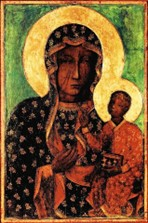
The dark hue of these figures has various speculations and controversies. Explanations range from the use of dark wood, darkening over time due to aging or candle smoke, to potential pagan origins or an intent to reflect darker-skinned indigenous populations. Another suggestion is that pre-Christian dark-skinned deities were re-envisioned as the Madonna and child.
Research into the Black Madonna phenomenon is limited, with early studies by Camille Flammarion (1888), Marie Durand-Lefebvre (1937), Emile Saillens (1945), and Jacques Huynen (1972) focusing on images in France. Leonard Moss, in 1952, categorized the images into three groups: those with physiognomy matching indigenous populations, those that darkened due to physical factors, and miracle-worker Madonnas found in areas of Roman legions.
The significance of the dark complexion to pilgrims and worshippers is also explored by scholars, who suggest that their unusual presence makes their shrines revered pilgrimage sites. Monique Scheer attributes the importance of the dark-skinned depiction to its connection with authenticity, stemming from the perceived age of the figures.
Notable examples of Black Madonnas include:
Africa:
- “Our Lady of Africa” in Algiers, Algeria
- Madonna and child in the Basilica of Our Lady of Peace, Yamoussoukro, Côte d’Ivoire
- “Notre-Dame de la Délivrance” in Popenguine, Senegal
- “The Black Madonna” in Soweto, South Africa
Asia:
- Japan: Black Madonna statue at Tsuraoka Catholic Church, Yamagata Prefecture
- The Philippines: Our Lady of the Rule of Opón (Lapu-lapu City), Our Lady of Guidance (Ermita, Manila), Nuestra Señora de la Paz y Buen Viaje de Antipolo (Antipolo, Rizal), and many others.
- India: Dhori Mata and Korvi Mata
- Turkey: Sümela Monastery, Trabzon
Europe:
- Austria: “Schwarze Madonna von Loreto” in St. Andrä im Lavanttal
- Belgium: “Our Lady of Regla” in Brugge, “De Zwerte Lieve Vrouwe” in Brussels, and several others.
- Croatia: Our Lady of Bistrica, Queen of Croatia in Marija Bistrica
- Czech Republic: Black Madonnas in Brno, Prague, and the Troja Chateau chapel.
- France: Numerous “Vierges Noires” across the country, including those in Rocamadour, Chartres (Notre-Dame-de-Sous-Terre), Le Puy-en-Velay, and the Basilica Notre-Dame de la Daurade in Toulouse.
- Germany: Gnadenkapelle in Altötting, St. Maria in der Kupfergasse in Köln, and various others.
- Greece: Hidden church of the Black Madonna, Vamos, Crete.
- Hungary: Our Lady of the Immaculate Conception in the Cathedral Basilica of Eger.
- Ireland: Our Lady of Dublin in Whitefriar Street Carmelite Church.
- Italy: Black Virgin of Oropa, Madonna di Canneto, Our Lady of Tindari, and many others, including the “Mamma Schiavona” at the Sanctuary of Montevergine.
- Kosovo: Church of the Black Madonna in Vitina-Letnica.
- Lithuania: Our Lady of the Gate of Dawn and Our Lady of the Pine Woods.
- Luxembourg: Esch-sur-Sûre, Grund (Luxembourg City), St. John’s Church (Luxembourg City).
- Macedonia: Madonna icons in Kališta Monastery and Ohrid Church.
- Malta: Our Lady of Atoċja (“Il-Madonna tas-Samra”) in Ħamrun.
- Poland: The famous Black Madonna of Częstochowa at the Jasna Góra Monastery.
- Portugal: Sanctuary of Our Lady of Nazaré.
- Romania: “Maica Domnului Siriaca” in Ghighiu and “Madona Neagra” in Cacica.
- Russia: Theotokos of St. Theodore in Kostroma and Our Lady of Wladimir.
- Serbia: Blessed Virgin Mary Catholic Church in Apatin and the Serbian Orthodox Three-handed Black Madonna in Hilandar.
- Slovenia: St. Anne’s Church, Koprivna.
- Spain: Nuestra Señora de la Cabeza (Andújar), Mare de Déu de Montserrat (“La Moreneta”) in Catalonia, and Nuestra Señora de la Candelaria (“La Morenita”) in Tenerife, among others.
- Sweden: Black Madonna with child in Lund Cathedral crypt and Skee Kyrka.
- Switzerland: Our Lady of the Hermits in Einsiedeln and others.
- Ukraine: Tsarytsya Karpat (The Queen of the Carpathian Land) at Hoshiv Monastery.
- United Kingdom: St. Mary Willesden (Our Lady of Willesden) and Our Lady of Częstochowa (Nottingham).
North America:
- Costa Rica: Basílica de Nuestra Señora de los Ángeles, Cartago.
- Cuba: Nuestra Señora de Regla, Regla, Havana Province.
- Mexico: Our Lady of Guadalupe, Tepeyac, Mexico City.
- Trinidad and Tobago: La Divina Pastora, Siparia, and Our Lady of Montserrat, Gran Couva.
- United States: National Shrine of Our Lady of Czestochowa (Doylestown, Pennsylvania), Black Madonna Shrine and Grottos (Pacific, Missouri), and various others.
- Canada: Black Madonna chapel at Ciociaro Club, Windsor, Ontario.
South America:
- Brazil: Our Lady of Aparecida or Our Lady Appeared (Nossa Senhora Aparecida) in Aparecida, São Paulo.
- Chile: La Virgen Morena (The Brunette Virgin) in Andacollo.
Summarized from Wikipedia https://en.wikipedia.org/wiki/Black_Madonna
Sources cited:
- “Black Madonnas: Origin, History, Controversy”. udayton.edu. The Jungian scholar, San Begg published a study of Black Virgins and their possible pagan origins.
- Jump up to:a b Begg, Ean (2017). The Cult of the Black Virgin. Chiron Publications. ISBN 978-1630514419.
- Jump up to:a b Moss, Leonard W.; Cappannari, Stephen C. (1953). “The Black Madonna: An Example of Culture Borrowing”. The Scientific Monthly. 76 (6): 319–324. Bibcode:1953SciMo..76..319M. ISSN 0096-3771. JSTOR 20482.
- L’Atmosphère : Météorologie populaire (1888), édition avec gravures fr.
- Filler, Martin “A Scandalous Makeover at Chartres”, The New York Review of Books, December 14, 2014
- Ramm, Benjamin. “A Controversial Restoration That Wipes Away the Past”, The New York Times, September 1, 2017
- Scheer, Monique (2002). “From Majesty to Mystery: Change in the Meanings of Black Madonnas from the Sixteenth to Nineteenth Centuries”. The American Historical Review. 107 (5): 1412–1440. doi:10.1086/532852. JSTOR 10.1086/532852.
- “Algiers”. interfaithmary.net. Archived from the original on 2017-08-11. Retrieved 2014-08-06.
- “Senegal”. interfaithmary.net. Archived from the original on 2017-08-11. Retrieved 2014-08-06.
- “Soweto”. interfaithmary.net. Archived from the original on 2017-08-11. Retrieved 2014-08-06.
- “Experiencetsuruoka.com”. Archived from the original on 2017-09-03. Retrieved 2017-09-03.
- “黒いマリア像“. Catholic Tsuruoka Church. 2025-04-19.
- Baybay, Felicito S., “Patron Ng Kapayapaan At Mga Manlalakbay” Archived 2014-08-08 at the Wayback Machine
- KD. “Our Lady Of The Rule National Shrine – Quirks of Life”. quirksoflife.com. Archived from the original on 2022-01-18. Retrieved 2014-08-06.
- Darang, Josephine. “Special Mass for Our Lady of Piat held July 9 at Sto. Domingo Church”, Philippine Daily Inquirer, June 26, 2011
- ^ Republic of Turkey Ministry of Culture and Tourism. “Sümela Monastry (sic)”. Retrieved 21 November 2020.
- ^ “Your Question”. udayton.edu. Archived from the original on 2015-02-19. Retrieved 2014-08-06.
- ^ “Brno – The Black Madonna”. brno.cz. Archived from the original on 2013-09-28. Retrieved 2013-08-16.
- ^ “Church of Our Lady Below the Chain in Prague”, Prague.cz Archived November 29, 2014, at the Wayback Machine
- ^ Channell, J., “Notre-Dame des Graces”, Aix-en-Provence[usurped]
- ^ “Black Virgin of Aurillac”. amigo.net. Archived from the original on 15 May 2008.
- ^ “A Controversial Restoration That Wipes Away the Past (Published 2017)”. The New York Times. Archived from the original on 2019-12-13.
- ^ “Notre Dame de Clermont”. 2007-12-19. Archived from the original on 2007-12-19. Retrieved 2009-07-25.
- ^ “Douvres”. interfaithmary.net. Archived from the original on 2017-08-11. Retrieved 2014-08-06.
- ^ “Notre Dame de La Chapelle Geneste”. amigo.net. Archived from the original on 14 May 2008.
- ^ “Notre Dame du Puy, Cathedrale…: Photo by Photographer Dennis Aubrey”. photo.net. 2007-11-09. Archived from the original on 2009-02-07. Retrieved 2009-07-25.
- ^ “Black Virgin of Marseilles”. amigo.net. Archived from the original on 15 May 2008.
- ^ “Black Virgin of Mauriac”. amigo.net. Archived from the original on 14 May 2008.
- ^ “Meymac”. interfaithmary.net. Archived from the original on 2017-08-11. Retrieved 2014-08-06.
- ^ Mariancalendar.org
- ^ “Black Virgin of Riom”. amigo.net. Archived from the original on 14 May 2008.
- ^ “The Sanctuaries”. visit-dordogne-valley.co.uk. Archived from the original on 2014-07-05. Retrieved 2014-08-06.
- ^ Garth Cartwright (2011-03-26). “Partying with the Gypsies in the Camargue”. the Guardian.
- ^ “Gypsy’s Pilgrimage – Les Saintes Maries de la Mer – Camargue – France”. avignon-et-provence.com.
- ^ “Notre Dame du Château”. amigo.net. Archived from the original on 14 May 2008.
- ^ “Vierge des Croisades”. 2007-12-19. Archived from the original on 2007-12-19. Retrieved 2009-07-25.
- ^ Vanished Kingdoms: The History of Half-Forgotten Europe, Norman Davies
- ^ Maria Farneti and Bruno Bartoletti, “Gubbio: The Italian Rennes-le-Chateau”, ‘Hera’, issue 43, September 2005[usurped]
- ^ Gubbio e il mysterious del “NIGER REGIN”
- ^ “IL MONTE TEMPIO E LA PIRAMIDE DI GUBBIO” by Mario Farneti & Bruno Bartoletti
- ^ “Il santuario di Montevergine: La Madonna di Montevergine”. Archived from the original on 2010-07-24. Retrieved 2024-07-27.
- ^ “Gay Madonnas in Montevergine: The Feast of Mamma Schiavona”. The White Review. Retrieved 2024-07-27.
- ^ Collegamento Nazionale Santuari (10 October 2016). “Madonna del Sacro Monte di Viggiano”. Retrieved 21 November 2020.
- ^ Yonat Shimron (17 August 2016). “Pilgrims crowd church where Mother Teresa once prayed”. Religion News Service. Retrieved 21 November 2020.
- ^ “St. John’s Church”. Luxembourg City Tourist Office. Retrieved 21 November 2020.
- ^ “Książka – Czarna Madonna”. Archived from the original on 2022-01-18. Retrieved 2020-09-03.
- ^ “Tel Aviv – the Icon of Black Madonna from St. Peters Church in Old Jaffa Stock Image – Image of jaffa, architecture: 56128953”. Archived from the original on 2022-01-18. Retrieved 2020-09-03.
- ^ “TEL AVIV, ISRAEL – MARCH 2, 2015: The Icon of black Madonna from st. Peters church in old Jaffa by unknown artist from end of 19. Cent”. Archived from the original on January 18, 2022. Retrieved September 3, 2020.
- ^ “Zdjęcie Stock: Tel Aviv – Icon of black Madonna from st. Peters church”.
- ^ “Jerusalem – mosaic of Madonna in Dormition abbey Poster • Pixers® • We live to change”.
- ^ “Jerusalem – mosaic of Madonna in Dormition abbey Sticker • Pixers® • We live to change”.
- ^ Dhalai, Richard, “La Divina Pastora”, Trinidad and Tobago Newsday, March 19, 2007
- ^ Nationaltrust.tt